


News
Bold M&A Creates Synergy… Even NASA Comes Calling
2026. 3. 24
[Bold M&A Creates Synergy… Even NASA Comes Calling]
“I would like you to take over the company.”
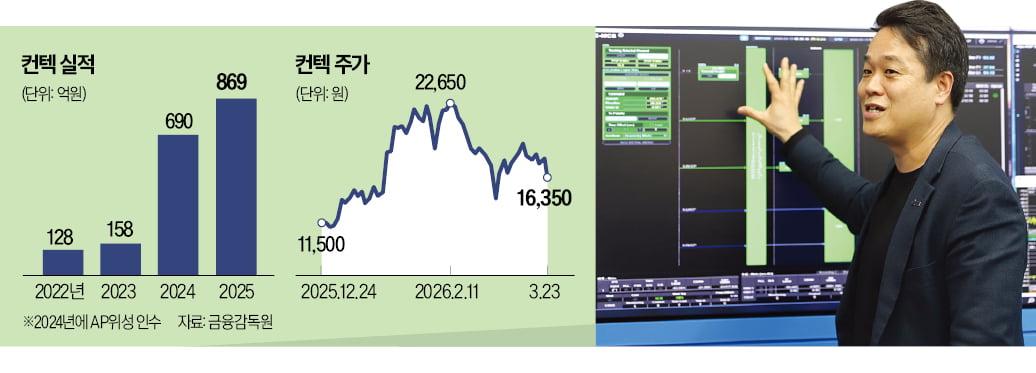
CEO Lee Sung-hee of Contec (pictured) clearly remembers meeting Chairman Ryu Jang-soo of AP Satellite in the early hours of April 2024 at Eunpyeong St. Mary’s Hospital in Seoul. At the time, Chairman Ryu was considering selling management control of AP Satellite and had received offers from several major domestic defense companies. The first-generation space industry founder, more than twenty years older than Lee, hesitated for nearly two hours before saying, “You understand the space industry properly, so you are the right person for our company.”
◇ Synergy from SME-to-SME M&A ◇
In an interview at Contec’s headquarters in Daejeon on the 23rd, Lee recalled the acquisition, saying, “Even two days before signing the main contract, a major defense company was actively pursuing the acquisition of AP Satellite. I think Chairman Ryu highly valued our company’s experience and energy in pioneering overseas markets from the ground up.”
About a month after meeting Chairman Ryu, Lee completed the merger and acquisition of AP Satellite. The total acquisition cost was 63 billion won, about four times Contec’s annual revenue in 2023 (15.8 billion won).
AP Satellite is the only company in Korea that possesses design technology for onboard computers (OBC)—the “brain” of satellites—and modem chips, which are core to satellite communications. Chairman Ryu judged that the synergy between Contec and AP Satellite would be far greater than selling management control to a large corporation. Contec operates in the downstream sector of the satellite industry, installing and managing ground stations and analyzing imagery. It has a ground station network in 14 countries—the largest in Asia. AP Satellite, on the other hand, is an upstream company that manufactures satellite bodies and payloads and has technology for data processing units and communication terminals.
Through the acquisition, Contec secured a “turnkey solution” capable of providing satellite manufacturing, launch, ground station operation, and image analysis all at once. Lee emphasized, “Our integrated solution can reduce costs by 20% compared to competitors and significantly shorten production time.” This synergy is already reflected in the company’s performance. Last year, Contec’s revenue reached 86.9 billion won, up 25.9% from 69 billion won the previous year.
◇ Rising Value Amid Iran War ◇
With the outbreak of the Russia–Ukraine war and conflicts between the United States, Israel, and Iran, Contec’s value has been rising. The importance of observation satellites, which can monitor enemy movements 24/7, has increased. Lee noted, “In the past, demand was satisfied with 1-meter resolution, but now it requires ultra-high resolution of 0.3 meters or even 0.1 meters. In particular, the quantity and quality of data are crucial.”
As resolution improves, data volume increases exponentially, making it difficult to download within the existing 8–10 minutes of communication time. Contec’s optical ground station (OGS) technology enables data transmission up to 10 times faster than conventional radio frequency methods. In addition, its quantum key distribution (QKD) technology prevents interception by using quantum encryption keys. Lee added, “There are only a few private companies in the world with both OGS and QKD technologies. Recently, NASA even proposed collaboration on lunar and Mars exploration projects.” He also revealed that turnkey solution proposals have already been submitted to emerging space nations such as Indonesia, Kazakhstan, and Mongolia, with multiple contracts nearing completion.
Lee also expressed his ambition to build a space industry ecosystem. To this end, he plans to establish a company within the next three years that will invest in space-related startups and venture firms. “The space industry requires not only launch vehicles and satellite technology but also a vast range of technologies, including medicine and space debris removal,” Lee explained. “Rather than developing all of these ourselves, it is more effective for Contec to invest in related companies and help build an ecosystem.”
- New post
- There is no new post.
하단영역

Copyright © APSI. All Rights Reserved. Flr. 9, Unit 2, 98, Gasan digital 2-ro, Geumcheon-gu, Seoul, Republic of Korea
TEL : 02-2026-7777 FAX : 02-2026-7772 E-mail : question@apsi.co.kr
Copyright © APSI. All Rights Reserved.