


News
APSI, Joins Forces with Korea Automobile Testing & Research Institute to Develop “Space Exploration
2026. 2. 4
"APSI, Joins Forces with Korea Automobile Testing & Research Institute to Develop “Space Exploration Mobility””
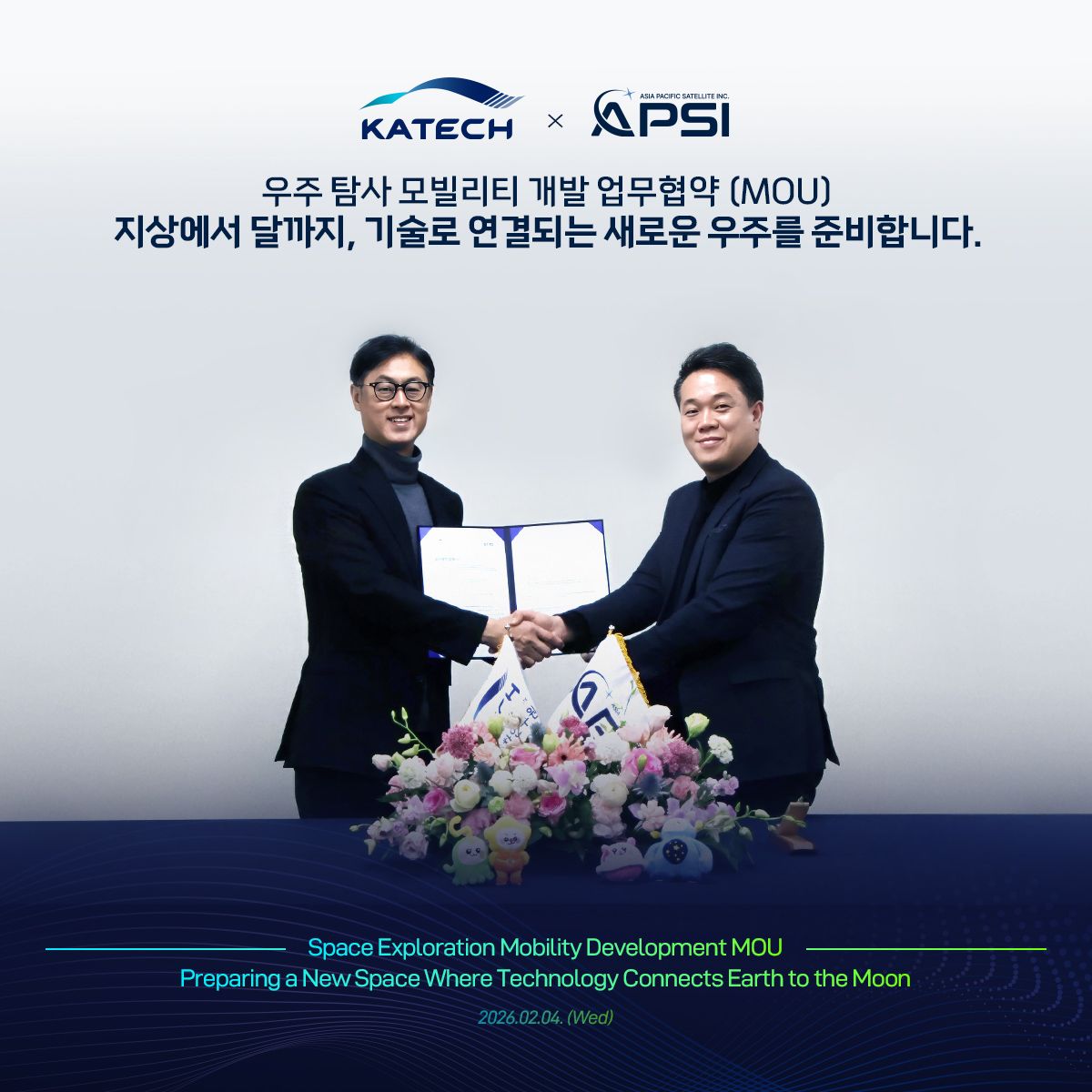
Jin Jong-wook, President of KATECH (left) – Lee Sung-hee, CEO of APSI
APSI, a leading Korean company specializing in space systems and satellite communication terminals, is expanding its business into the field of space exploration mobility.
On February 4, APSI announced that it signed a Memorandum of Understanding (MOU) with the Korea Automobile Testing & Research Institute (KATECH) at its headquarters in Geumcheon-gu, Seoul, to conduct joint research on space exploration mobility.
This partnership comes amid the acceleration of crewed lunar and Mars exploration programs by major space-faring nations, including NASA’s Artemis Program and Moon to Mars architecture, which resumed after the Apollo 17 mission, as well as similar initiatives led by China, Europe, and Japan. The agreement represents a strategic collaboration aimed at proactively securing core technologies in next-generation space mobility—particularly lunar exploration mobility—and responding effectively to the rapidly evolving global space industry landscape.
Under the agreement, the two organizations will jointly pursue research and development for space exploration mobility, advancing technology development, performance verification, and the establishment of evaluation systems in a phased manner. Through this collaboration, they plan to systematically build core competencies in the space mobility sector.
Key areas of cooperation include the development of a prototype lunar exploration mobility platform and the development of AI-integrated electronic systems for space mobility applications.
Jin Jong-wook, President of KATECH, stated,
“Space mobility is a key industry that will determine future national competitiveness. It is a market where challenges and opportunities coexist, requiring advanced technological capabilities and strong convergence expertise. Through this collaboration, we aim to secure core domestic technologies and promote the creation of an innovative ecosystem, thereby contributing to the enhancement of the global competitiveness of Korea’s space industry.”
Lee Sung-hee, CEO of APSI, emphasized,
“Satellites serve as a hyper-connected infrastructure linking space and Earth and are a core pillar of the future mobility ecosystem. We will expand connectivity across automobiles, UAM, satellite communications, and next-generation GEO networks, and further prepare a new space mobility paradigm that connects lunar and Martian ground stations, orbital data centers, and terrestrial mobility.”
He added,
“By broadening our vision to include new business models such as satellite servicing, docking, and space debris removal utilizing robotics technologies, we aim to lead the New Space era driven by the private sector.”
Meanwhile, APSI is a leading Korean company specializing in space and satellite system development, having accumulated extensive experience and achievements in satellite bus system development and payload localization through participation in major national projects, including performance verification satellites and multipurpose practical satellites.
Based on technologies whose performance and reliability have been proven after launch, APSI is recognized as a core technology company in the New Space era, where both lunar and deep-space exploration and private satellite demand are rapidly expanding.
With the completion of its Assembly, Integration, and Test (AIT) Center in the first quarter of this year, APSI will establish a one-stop system covering satellite manufacturing through testing and verification, further strengthening its competitiveness in securing private satellite projects and future national space programs.
하단영역

Copyright © APSI. All Rights Reserved. Flr. 9, Unit 2, 98, Gasan digital 2-ro, Geumcheon-gu, Seoul, Republic of Korea
TEL : 02-2026-7777 FAX : 02-2026-7772 E-mail : question@apsi.co.kr
Copyright © APSI. All Rights Reserved.