


News
LeoSpace Successfully Secures Strategic Investment from Contec and AP Satellite
2026. 1. 22
"LeoSpace Successfully Secures Strategic Investment from Contec and AP Satellite”
LeoSpace, a South Korean company specializing in small-satellite payloads, has secured strategic investments (SI) from satellite ground station operator Contec and satellite communications company AP Satellite. The three companies plan to embark on full-scale collaboration to build a NewSpace ecosystem encompassing satellite manufacturing, operations, and services.
LeoSpace announced on the 22nd that it signed strategic investment and business cooperation agreements with Contec and AP Satellite on the 9th. Through this investment, Contec and AP Satellite acquired minority equity stakes in LeoSpace. However, the specific investment amounts and shareholding ratios were not disclosed in accordance with the agreement.
This deal is drawing attention as it is not a simple financial investment (FI), but a strategic investment aimed at creating technological and business synergies. LeoSpace possesses advanced satellite payload development capabilities, and by partnering with companies that have ground station infrastructure and communications technologies, it is expected to establish a collaborative model covering the entire satellite industry value chain.
Full-Scale Integration of the Satellite Industry Value Chain
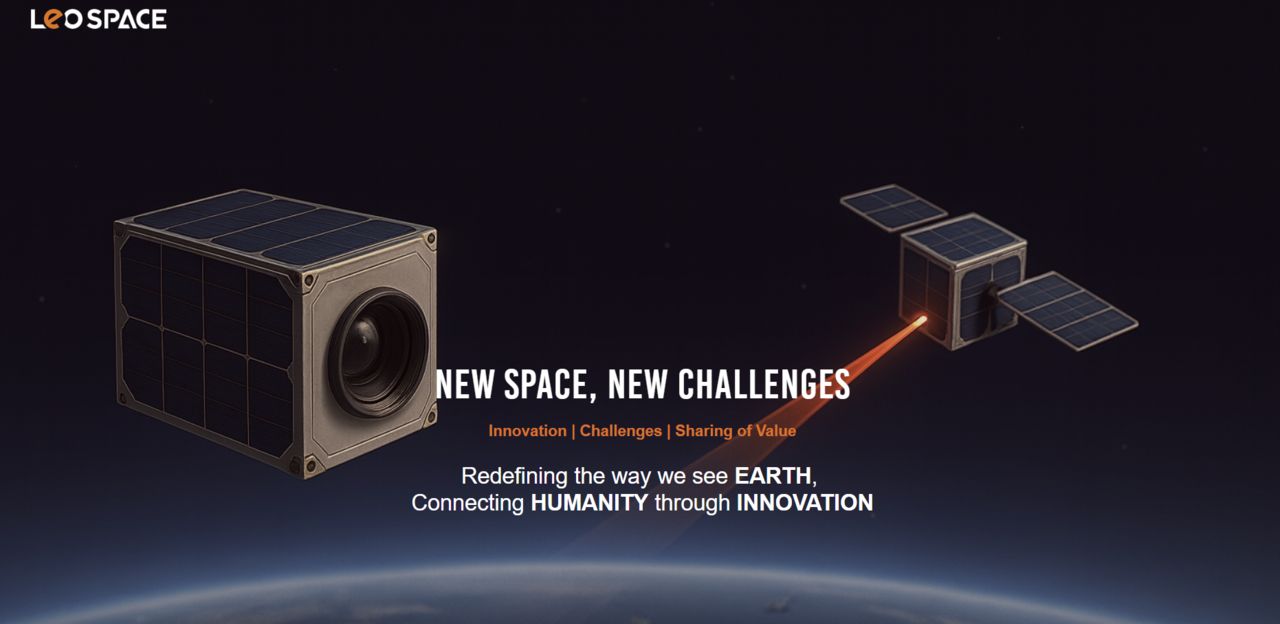
The agreement aims to organically link each company’s core technologies to provide integrated solutions across the full lifecycle of satellite operations. LeoSpace’s key competencies include high-resolution optical payloads for small satellites and laser communication technologies for inter-satellite and satellite-to-ground links (LCT). In particular, the company focuses on developing remote sensing payloads for low Earth orbit (LEO) satellites and free-space optical communication (FSOC) technologies, with the goal of localizing advanced space optical technologies.
Founded in 2021 and headquartered in Daejeon, LeoSpace is a space optics specialist company dedicated to the localization of space optical technologies. It is currently pursuing R&D for the commercialization of optical payloads for small satellites and laser communication technologies.
Contec will collaborate on operations, verification, and commercialization to ensure that LeoSpace’s payload and optical communication technologies operate reliably in mission environments, leveraging its global ground station network and satellite operation expertise. Contec will provide infrastructure to receive, process, and manage data collected and transmitted by satellites in orbit. AP Satellite, drawing on its accumulated expertise and business experience in satellite communications, will explore next-generation satellite communication technologies and jointly develop new business opportunities focused on NewSpace application markets.
Through this collaboration, the three companies aim to link the value chain from satellite payloads to ground stations and communication services, while expanding commercial missions and demonstration projects based on small and micro-satellites. They also plan to accelerate their entry into the global NewSpace market.
Step-by-Step Business Model Development: From PoC to Global Expansion
In the short term, the three companies plan to gradually expand their cooperation to include small-satellite constellation missions, ground station-linked proof-of-concept (PoC) projects, and joint business development targeting overseas NewSpace customers. LeoSpace intends to concretize a full-cycle business model covering satellite mission planning, payload development, ground station integration, operations, and service demonstrations. Rather than supplying individual technologies or products, the company aims to establish a mission-oriented integrated solution delivery system.
A LeoSpace representative stated, “The participation of Contec and AP Satellite as strategic investors is the result of recognition not only of our technological competitiveness but also of our growth potential in the NewSpace market. Starting from the agreement on January 9, we will pursue both technology validation and commercialization to achieve meaningful results in the global market.”
The three-way collaboration is being evaluated as a leading example of domestic companies moving beyond standalone technology development toward a value-chain-based cooperative model. An industry insider commented, “While many domestic space startups possess strong technological capabilities, they often face difficulties in commercialization and market entry. Strategic combinations of companies with technology, infrastructure, and market access can generate significant synergy.”
However, another industry source cautioned, “It will take time for this cooperative model to translate into actual revenue and profits. Concrete business outcomes and technology verification results will need to be closely observed.”
https://www.bloter.net
하단영역

Copyright © APSI. All Rights Reserved. Flr. 9, Unit 2, 98, Gasan digital 2-ro, Geumcheon-gu, Seoul, Republic of Korea
TEL : 02-2026-7777 FAX : 02-2026-7772 E-mail : question@apsi.co.kr
Copyright © APSI. All Rights Reserved.